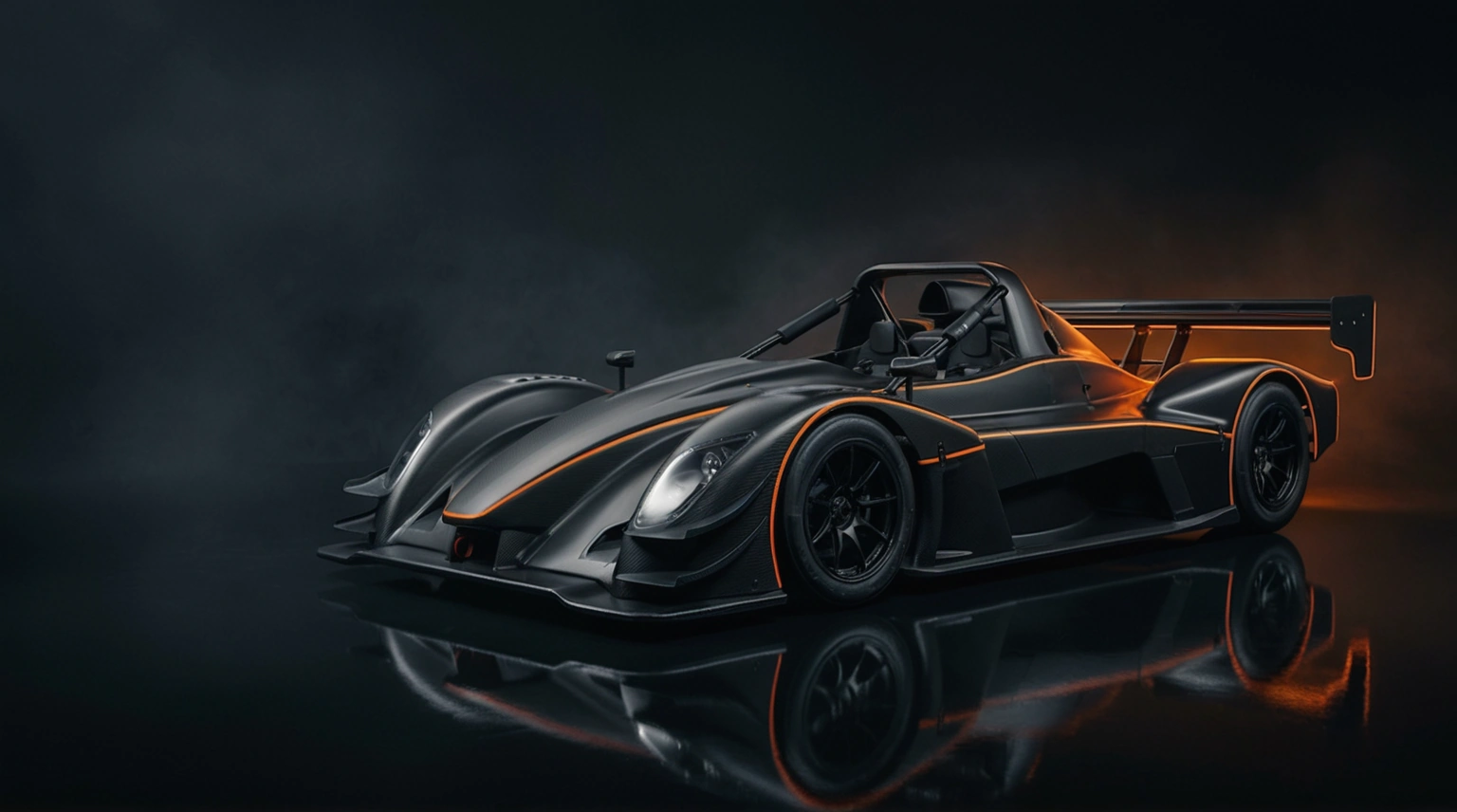
Race car prototypes, engineered to win
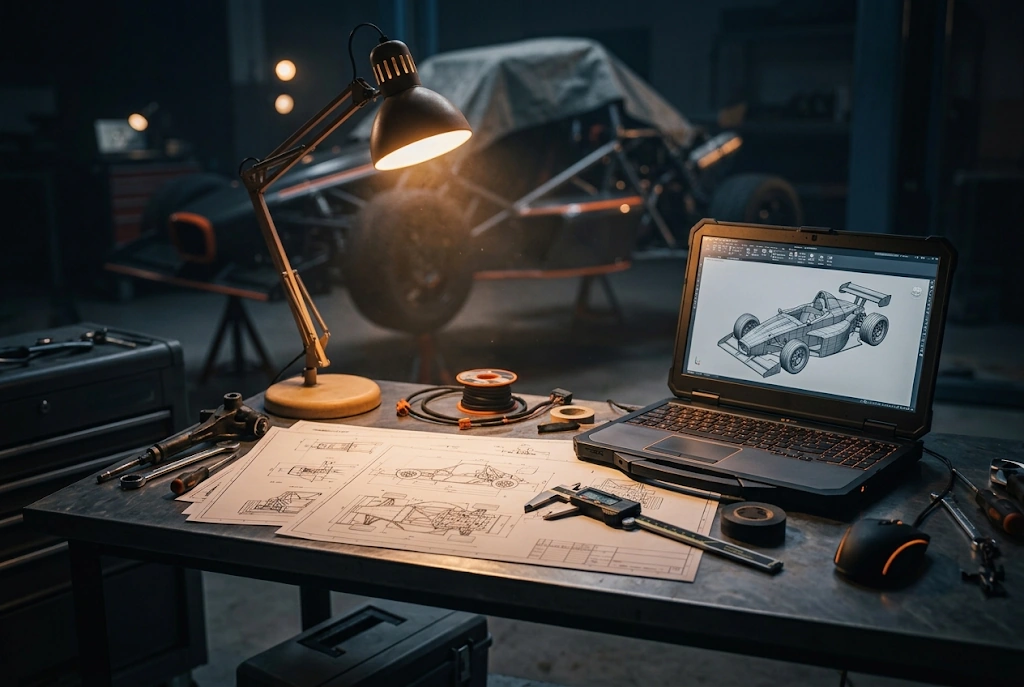
We design race car prototypes that are quick from the very first test. First, we calculate and validate the car virtually; only then is the first tube cut. As a result, the workshop builds once and the track is where you gain tenths.
CAD · FEA · CFD · Data · Hydrogen
engineer accountable for your project from start to finish
engineering disciplines brought together in one team
professional tools: CATIA V5, SolidWorks, Abaqus, Star-CCM+, MATLAB, MoTeC and Wintax
working languages, English and Spanish, for clients across Europe
Independent engineering for race car prototypes
ERGA Prototipos is an engineering consultancy in Irurtzun (Navarre, Spain) that designs race car prototypes. For example, we work on car cross, hillclimb CM and CM+, barchettas, sports prototypes, single-seaters and experimental electric or hydrogen vehicles.
However, we don’t sell an off-the-shelf chassis. Instead, we engineer your car around your regulations, your engine, your budget and your driving style. That is why you can commission the whole car or just the study you are missing.
Erga comes from the Greek ἔργα, “works”: in other words, engineering that proves itself on the stopwatch.
In addition, we work hand in hand with your workshop or the one you choose. We calculate and document; the workshop builds from clear drawings, cut lists and 3D models. As a result, every part reaches the first test with its engineering rationale and no room for misreading.
Where race car prototypes lose their time
Most projects don’t fail on track. However, they fail earlier, in the workshop, because of decisions nobody calculated.
Without prior calculation, every chassis change costs weeks and material, and it also delays the season.
Without reliable data, set-up depends on feel; therefore each test delivers less than it costs.
For example, a roll cage or mounting point outside the rules forces parts to be remade right before the race.
Our answer: we validate virtually everything that can be validated. In this way the workshop builds once, and the track is for winning, not for finding mistakes.
Complete engineering for race car prototypes
Eight disciplines in one engineering team, so you can hire the full project or only the service you need.
Spaceframe or monocoque chassis modelled in CATIA V5 and SolidWorks, with workshop-ready drawings.
Stiffness, strength and safety calculated in Abaqus before the first tube is welded.
Downforce, drag and cooling simulated in Star-CCM+ for wings, floors and bodywork.
Suspension geometry and kinematics designed for your class and your driving style.
MoTeC and Wintax telemetry turned into concrete set-up changes for tests and races.
Workshop, composites, machining and 3D printing coordinated up to the finished car.
Electric and hydrogen fuel-cell powertrains integrated into competition cars.
Design to RFEDA or FIA technical regulations and documentation for homologation.
From first sketch to chequered flag, in fixed-scope phases
In every phase you know what you get and when you get it. Moreover, at the end of each one you decide whether to continue, adjust or stop.
First, we analyse regulations, engine, budget, timeline and performance targets.
Next, we define the layout, weight distribution and first geometry targets.
Then comes full CAD, FEA, CFD and the manufacturing drawings.
After that, we coordinate the workshop, composites, machining and 3D printing.
Finally, shakedown, data acquisition and fine-tuning on track.
Race car prototypes we design
Every discipline has its own rulebook and its own way to win, so we design for yours.
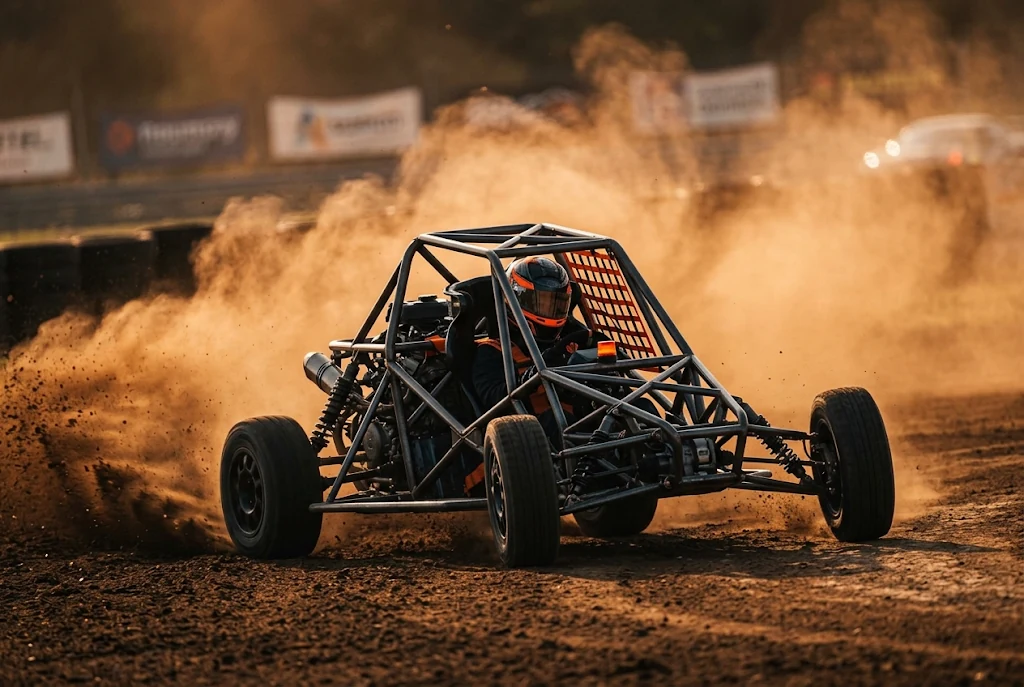
Above all, spaceframe chassis, long-travel suspension and bike engines: toughness and traction for dirt.
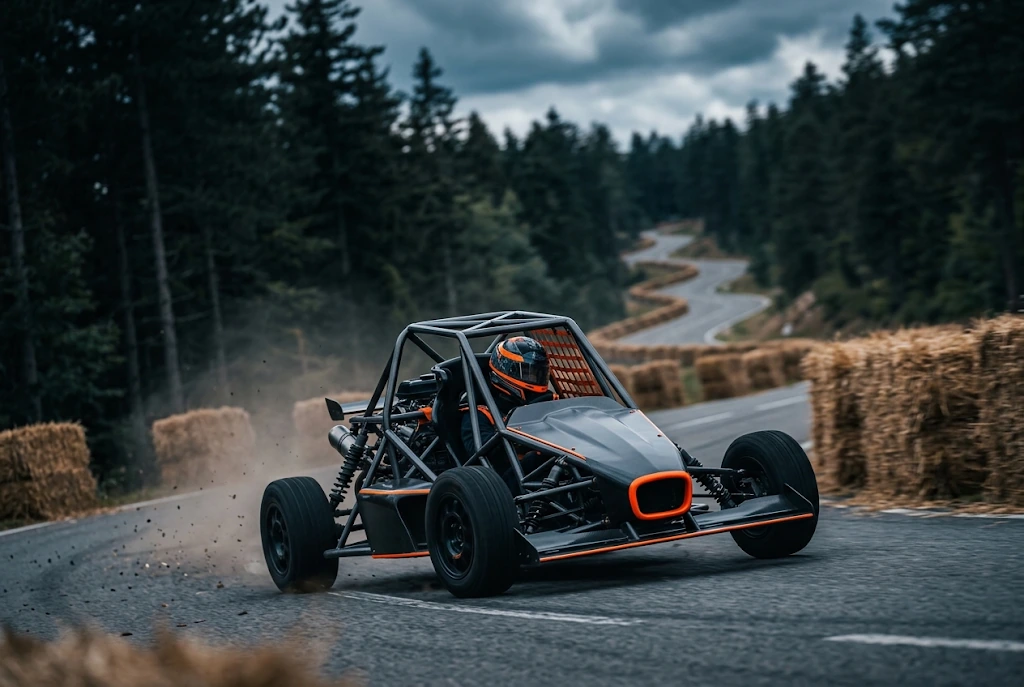
Lightweight hillclimb prototypes, because every kilo and every degree of geometry counts.
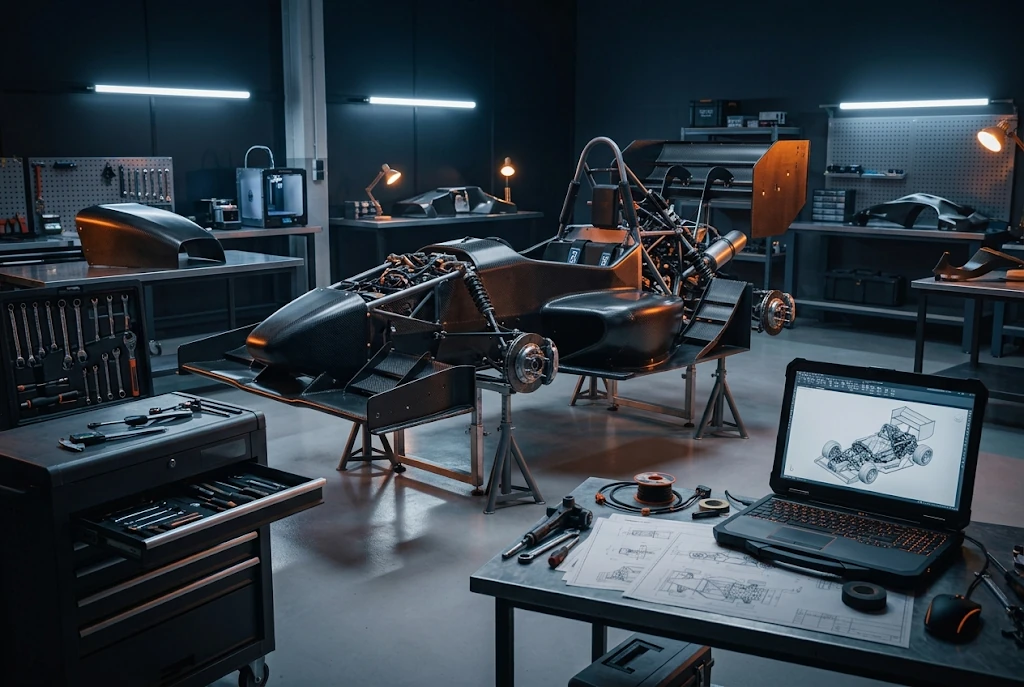
We also offer design reviews, FEA and CFD for university teams that want to go further.
Key terms you will hear in a project
These are the words we use most in a project. That is why we explain them briefly so that drivers, teams and engineers speak the same language.
A single-seat competition car with a spaceframe chassis, long-travel suspension and a motorbike engine that races on dirt tracks, especially in autocross.
Lightweight prototypes with motorbike engines that race mainly in hillclimbs. CM+ allows more power and therefore demands more from chassis and brakes.
An open-top prototype that, because it combines a light, stiff chassis with high downforce, is one of the fastest hillclimb classes.
The chassis’ resistance to twisting between the axles, expressed in Nm per degree. Consequently, the stiffer the chassis, the more the suspension works as designed.
Finite element analysis, that is, a method that splits a part into millions of small elements to calculate stresses and deformation before the part is made.
Computational fluid dynamics; in other words, a simulation of the air around the car that measures downforce, drag and cooling without a wind tunnel.
Sensors and a logger that record speed, suspension, brakes and engine. As a result, the car’s behaviour is analysed with numbers, not feelings.
The share of the total weight carried by each axle and each wheel. It is tuned with the position of the engine, the driver and the ballast, and it decides how the car enters and leaves each corner.
One engineer, from start to finish
Behind ERGA Prototipos there is an automotive and motorsport engineer with more than ten years of experience in R&D projects. That work covers vehicle dynamics and suspension, race car concept and design, structural integration and electric powertrains.
In addition, he covers the full prototype cycle: CAD modelling, finite element analysis, aerodynamic simulation and trackside data analysis. That is why, at ERGA, you always talk to the person who calculates your car.
CATIA V5 · SolidWorks · Abaqus · Star-CCM+ · MATLAB · MoTeC · Wintax
Frequently asked questions about race car prototypes
What exactly does ERGA Prototipos do?
We design and engineer race car prototypes: chassis, safety structures, suspension, aerodynamics, engine integration and data acquisition. We can deliver the whole car or a single study and, in addition, we coordinate manufacturing up to the track.
How much does it cost to design a race car prototype?
It depends on the scope and the class. For this reason, we work in fixed-scope phases, each with its own quote; so you can start with a single study, such as chassis analysis, and expand later.
How long does it take to design a race car?
In general, a single study takes a few weeks. In contrast, a complete prototype takes several months depending on the class and workshop lead times, and the proposal includes a phase-by-phase schedule.
Do you also build the car?
We coordinate manufacturing with specialist workshops for spaceframes, composites, machining and 3D printing. If you already have a trusted workshop, we can also hand over the drawings and 3D models.
Can you help homologate the car?
Yes. We design to the technical regulations of your class from the first sketch and, in addition, we prepare the technical documentation for the relevant body, such as the FIA.
Do you work with clients outside Spain?
Yes. In fact, most of the engineering is done remotely and, when the project requires it, we travel to the workshop or the track. We work in English and Spanish across Europe.
How do you handle my project information?
We only use it to study and develop your project and we do not share it with third parties, as explained in our privacy policy.
Got a race car prototype in mind?
Tell us the class, the regulations and the deadline. Then we will reply with an initial technical assessment.